Wednesday, May 12, 2021

Kursk to Barbarossa? Creating a Project

Osprey Publishing "Operation Barbarossa 1941 (1)  Army Group South"At 3:15 AM on Sunday morning June 22, 1941 the Axis forces lead by the German Army began the invasion of the Soviet Union.   The enormity of this invasion can be measured in one stat, eighty percent of the all the Axis Military forces were committed to battle in one fell swoop.  

The numbers are staggering.  The Axis forces committed 166 Divisions, 3.8 Million men, 3,400 armored fighting vehicles, and 2,700 aircraft.  The Soviet Union countered with 220 Divisions, 2.8 million men, 11,000 armored fighting vehicles, and 7,100 aircraft.    

Over the five months of combat during Operation Barbarossa (June 22 - December 5) the Axis forces suffered over 1 million casualties, including 186,000 Killed in Action, 660,000 wounded, 40,000 Missing in Action.   2,735 Armored fighting vehicles destroyed, 2,870 aircraft lost.  

The numbers for the Soviet Union were even higher.   567,000 Killed in Action, 1.3 million wounded or injured, 2.8 million Missing in Action, 21,000 Armored Fighting Vehicles destroyed, and 11,000 aircraft lost.     

This summer marks the 80th anniversary of Operation Barbarossa. I was reminded of this late last week.  After some discussion and some personal reflection it was decided to pivot our project to Operation Barbarossa.  

This change is not without issues.   Currently I have 0 German armored fighting vehicles for this era of WWII.  No Panzer II and Panzer III's that I own are from later in the war.   On the Soviet side I do own 3 T-26 Light Tanks 6 KV-1 Heavy Tanks.   

That changed with an order to Old Glory Miniatures over the weekend.   

On the Soviet side I have 3 platoons of painted infantry (2 SMG, 1 Rifle) plus 2 companies worth of assets (Anti-Tank, Anti-Tank Rifle, Mortar and Heavy Machine Gun) ready.   I have 3 platoons of infantry on the painting table (1 SMG and 2 Rifle), 1 company of T-26 Light Tanks and 1 company of KV-1 Heavy tanks.  

On the Axis Side I have 1 squadron of German Cavalry, 2 platoons of German Infantry and 1 company worth of German Tanks, once my order from Old Glory is received.

Thursday, April 15, 2021

Kursk! Creating a Project

 Why it is Interesting to Wargamers

The pure scale of the battle.  

The Battle of Kursk is one of the largest single battles of WWII involving 2,000,000 troops, 6,000 armored fighting vehicles, and 4,000 aircraft.  It is difficult to place that in scale of how large a battle that was especially for those of us who grew up in the west.    The fighting on D-Day involved 200,000 men and the height of operations in the North West Europe Theater of Operations was a combined total of 2,750,000 men prior to the push into Germany in 1945.

The gamers belief that the German's were close to victory.   

Often when gamers look at large battles they key into small decision declaring "I would never do that, it cost them victory."  The Battle of Kursk, or rather the individual engagements offer plenty of those small decisions.  Some large ones as well.  
As an individual with a History Degree and reading five to many books on the topic, the Germans were never in a position to win the battle.  Even if they did it wouldn't really change anything.   They were grossly out numbered on multiple fronts and the American war machine was now in high gear.        
As an scenario designer it appears feasible to build multiple scenarios on both the northern and southern fronts that have opportunity for both sides to succeed and win.   

Tanks, Tanks and more Thanks.  

With over 6,000 armored fighting vehicles engaged, Kursk is the largest tank battle in history.   A gamers delight as it were.   
On the Western Front to adequately have a historic game you should have roughly 9 to 10 stands of infantry for every single stand of Armor.   Gamers "love" tanks and only begrudgingly play infantry, as a general rule of thumb.   So you usually see too much armor represented on the western front, from the Western Desert to Northwest Europe.   At Kursk depending on the exact engagement it is more of a one to one ratio at the platoon level.   .    

Tuesday, April 13, 2021

Kursk! - Creating a project


Background

Operation Barbarossa began on 22 June 1941 as the German Military and its allies began the invasion of the Soviet Union, creating the Eastern Front.  The onslaught of the German Military might continued for nearly 6 months as they pushed the armed forces of the Soviet Union back over 600 miles.   In December 1941 the German Offensive stalled and the Soviet Counter offensives began creating a war of attrition the Germans and their allies could not win.

In the spring of 1942 the Germans had stabilized the Eastern Front and began a new series of offensive attacks to defeat the Soviet armed forces.   The Soviets prepared for the summer offenses of the Germans by planning to defend Moscow at all costs.   The German offenses of summer of 1942 practically ignored Moscow as they targeted other strategic locations.   One of these German offenses targeted the Soviet city of Stalingrad in the Southwest of Russia.   Stalingrad was an essential transportation hub on the Volga river, connecting the greater Soviet Union to resources of the southern Russia, namely oil.   The Germans also saw propaganda in taking a city named after the leader of the Soviet Union, Josef Stalin.      

The battle of Stalingrad began in August 1942 and quickly turned into a grinding back and forth inch by inch battle.   As the calendar neared the end of 1942 the Soviet Army launched two offenses of their own near Stalingrad, Operation Uranus and Operation Little Saturn.    The conclusion of Operation Little Saturn saw the German Sixth Army surrounded and in February 1943 the German Sixth Army Surrendered.  

The loss of the German Sixth Army nullified much of the gains of the German Army and their allies had achieved in Caucus region of the Soviet Union during the summer of 1942.   In early spring 1943 the German Army planned a summer offensive which would isolate and destroy several individual Soviet Armies.  The plan was to allow the Soviets to reinforce a salient or outward bulge in the front lines of the Eastern Front near the Soviet City of Kursk.   

The Germans Wehrmacht (Army) were desperately under strength at this point, the average unit was between 33% and 50% undermanned.   This factor pushed the lead from the Wehrmacht's infantry divisions to the German Mechanized Panzer Divisions.     

In 1941 and 1942 the Military Intelligence of the Soviet Armed forces were virtually blind to the German Plans.   They made guesses based upon what the knew and were wrong more often then they were right.   In 1943 it was different story.   The British Intelligence agency was sharing decoded high level communications between the German Command in the field and headquarters in Berlin, they had cracked the enigma code.   The Soviet military planners planned a war of attrition using a defense in depth strategy.   With a defense in depth strategy the Soviet military planners also allowed for floating reserves giving local commanders the ability to commit these forces.   

The German offensive started on July 5 and lasts 11 days.   The Soviet counter offense begins on July 12 and lasts until August 23rd.   

The battle of Kursk, or battles if you'd prefer, took place halfway between the invasion of Soviet Union with Operation Barbarossa and the surrender of the German Armies to the Allies.   The result of the battle was a tactical stalemate for both sides, but a strategic victory of the Soviet Union.   The Germans for the first time did not break through the Soviet defenses.   The Soviet losses were horrific.   The cost of men and machine are still debated in academic circles today.         

Thursday, January 3, 2019

First Crusade - Figure Census

Franks

Bohemond of Taranto (Norman Crusader)

  • Bohemond of Taranto 
  • Tancred Hauptville
  • Richard of Salerno 
  • 6 Stands of Armored Knights
  • 6 Stands of Armored Knights 
  • 8 Stands of Protected Spearmen
  • 8 Stands of Protected Spearmen 
  • 6 Stands of Unprotected Crossbowmen
  • 6 Stands of Protected Crossbowmen
  • 8 Stands of Pilgrims

First Crusade - Hugh, Count of Vermandois (French Crusader)

  • Hugh I
  • 4 Stands of Armored Knights
  • 8 Stands of Protected Spearmen
  • 6 Stands of Unprotected Crossbowmen
  • 4 Stands of Pilgrims

Byzantine Tatikios 

  • Emeperor Alexis Komnenos
  • Tatikios
  • 4 Stands Klibanophoros
  • 6 Stands Kapaphractos
  • 6 Stands Latinkon
  • 4 Stands Turcopoles
  • 8 Stands Varangians
  • 8 Stands Defensive Spearmen
  • 6 Stands Protected Archers
  • 6 Stands unprotected Archers
  • 6 Stands Pechenegs Protected Light Cavalry

Saracen

Sulatanate of Rum - Kilij Asalan

  • Kilij Asalan
  • 6 Stands Protected Light Cavalry - Turcoman
  • 4 Stands Protected Light Cavalry - Turcoman
  • 4 Stands Protected Light Cavalry - Turcoman
  • 6 Stands Protected Javelinmen
  • 6 Stands Unprotected Spearmen - Ahdath Militia
    • 3 Stands Unprotected Bowmen - Ahdath Militia

Fatimid Caliphate - Al-Afdal Shahansha

  • Al-Afdal Shahansha | Field Commander
  • Troop Commander
  • 6 Stands Arab Lancers
  • 4 (+2)  Stands Arab Lancers
  • 6 Stands Abid al-shira | Protected Spearmen - Sudanese Spearmen
    • 3 Stands Unprotected Bowmen - Light Infantry - Sudanese Bowmen
  • 6 Stands Abid al-shira | Protected Spearmen - Sudanese Spearmen
    • 3 Stands Unprotected Bowmen - Light Infantry - Sudanese Bowmen
  • 6 Stands Armenia Archers 
  • 6 Stands Sariraya | Protected Defensive Spearmen - 
    • 3 Stands Unprotected Bowmen - Light Infantry
  • 6 Stands Unprotected Bowmen - Sudenese Bowmen
  • 4 Stands Unprotected Light Cavalry - Bedouin 

A few Clan War Figures recently Painted Up

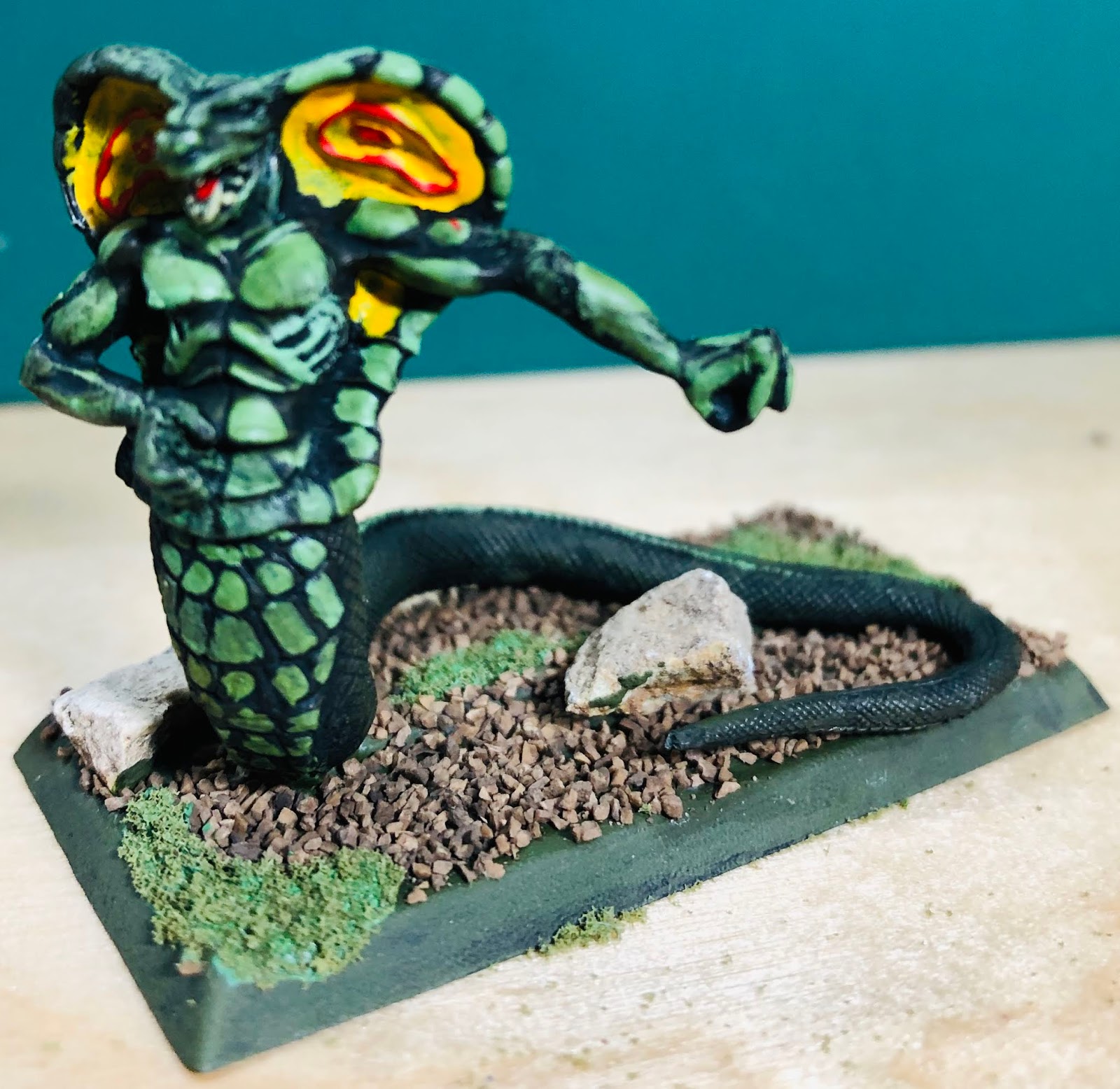
Isha - Naga Hunter

Oni no Sanru

Kyoso no Oni
Naga Shugenja

Naga Warlord

Troll
Demon Bride of Fu Leng and Yogo Junzo

Tuesday, January 1, 2019

1813 Austrian II Corps - Leipzig

Austrian II Corps

17 battalions, 10 squadrons and 7 batteries
Merveldt, GK Maximilian-Friedrich, [Reichsgraf] Freiherr von

Light Division
Lederer, FML Ignatz
Brigade Sorenberg, GM
Grenz Infantry Gradiskaner: 1 battalion (8 Stands)
Hussar Regiment Freiherr von Kienmayer Nr. 8: 6 squadrons (6 Stands)
Dragoon Regiment Erzherzog Johann-Baptist Nr. 1: 4 squadrons (6 Stands)
1 Battery: 8 guns (2 Stands)
Brigade Longueville, GM
Infantry Regiment Freiherr von Strauch Nr. 24: 2 battalions (2 x 6 Stands)
Infantry Regiment Graf Bellegarde Nr. 44: 2 battalions (2 x 8 Stands)
1 Foot Battery: 8 guns (2 Stands)
Line DivisionLiechtenstein, FML Alois, Prinz zu
Brigade Ensbruck, GM
Infantry Regiment Graf Kaunitz-Rietberg Nr. 20: 3 battalions (2 x 8 Stands and 1 x 6 Stands Landwehr)
Infantry Regiment Wenzel, Graf Colloredo-Waldsee Nr. 56: 3 battalions (3 x 8 Stands)
6-pdr Foot Battery: 8 guns (2 Stands)
Brigade Mecsery, GM Johann-Karl, Freiherr von
Infantry Regiment Freiherr von Vogelsang Nr. 47: 3 battalions (2 x 8 Stands and 1 x 6 Stands Landwehr)
Infantry Regiment Heinrich XIII, Prinz zu Reuss-Greitz Nr. 18: 3 battalions (2 x 8 Stands and 1 x 6 Stands Landwehr)
1 Foot Battery: 8 guns (2 Stands)
II Corps Reserve Artillery
1 – 12pdr Foot Battery: 6 guns (2 Stands)
2 – 6pdr Foot Batteries: 12 guns (2 x 2 Stands)

Source Napoleon Series

Battle of Lindenau - AAR

At the Centurions extra Saturday event at the Source Comics and Games I ran a 25mm Napoleonic Game using Rank and File:Horse and Musket Rules 1740-1900.  It has been a while since the 25mm Napoleonic Collection was out of the box and on a tabletop so the extra session was an opportunity to do something different.

As a group we have long discussed tactical rules for the Napoleonic period, heck I have a box with 56 different rule sets in it as we have hunted for something.   Nothing has really caught on.   We looked at Rank and File for an American Civil War project in the early 2000's, but Regimental Fire and Fury has become the defacto set of rules for that period.  I have written my own set of rules for the Napoleonic Period; however they are too much in depth for a club game.   That lead to the decision to give Rank and File a try.

The scenario was loosely based around the Austrian III Corps attempt to lure the French into battle near Lindenau on the west bank of the Elster River near Leipzig Bavaria.

Austrian Order of Battle
Austrian Third Brigade Marching on.
  First Division
    First Brigade
      Grenzer - 24 Figures
      Jagers - 20 Figures
      Light Artillery
    Second Brigade
      Landwher - 20 Figures
      Landwher - 20 Figures
      Light Artillery
  Second Division
    Third Brigade
      Line - 32 Figures
      Line - 32 Figures
      Line - 32 Figures
      Line - 32 Figures
      Medium Battery
  Heavy Battery

Russian First Division
Russian Order of Battle
  First Division
    Line - 16 Figures
    Line - 16 Figures
    Line - 16 Figures
    Line - 16 Figures
    Medium Battery
  Second Division
    Line - 16 Figures
    Line - 16 Figures
    Line - 16 Figures
    Line - 16 Figures
    Heavy Battery


French First Brigade
French Order of Battle
  First Division
    First Brigade
      First Regiment
        Line - 24 Figures
        Line - 24 Figures
       Second Regiment
        Line - 24 Figures
        Line - 24 Figures 
      Medium Battery
    Second Brigade
      Fourth Regiment
French Defensive Position near Lindenau
        Line - 24 Figures
        Line - 24 Figures
      Fifth Regiment
        Line - 24 Figures
        Line - 24 Figures 
      Medium Battery
  Second Division
    First Brigade
      Legere - 24 Figures
      Line - 24 Figures
    Second Brigade
      Light Cavalry - 8 figures

  Cavalry Brigade
    Heavy Cavalry - 12 Figures
    Heavy Cavalry - 12 Figures


The game opened with the Austrian and Russian forces marching on from three designated points. The Russians from the north road, the main Austrian Force in the center and the Lighter Austrians in the south road.   

The French broke up their batteries prior to thee game and then attempted to form a grand battery to control the center of the table.  

Noel, Fitz and Steve
The Russians made a conscious effort to avoid the center of the table and hug the left edge.  A battalion of French attempted to take a fence line to have cover against the fire.

The Austrians began the slow plodding march from the west end of the board towards the center.   Did I say slow plodding march, okay just wanted to make sure everyone was aware how slow they moved.   

  • Note: I explained Marching (Double movement) a couple of times to the players and emphasized it to the Austrian Players however I didn't force it upon them.


Austrian Light Brigade moving through the woods
The artillery duel began in the center as the French grand battery attempted to break up the Russian Attack.
French First Brigade deployed

The Russians pushed on the Northern Flank and by turn two had pushed back the French advance elements out of the fenced area.

For the next several turns the Russians and the French on the North flank traded fire and the Austrians slowly plodded along in the center.

The Russian heavy battery deployed and began trading fire with the French grand battery.

The French in a gambit through out a Light Cavalry Regiment in an attack against the Russian flank.   The Russians formed square and French whithered under the fire before bouncing.

The advance elements of the Austrians finally engaged the French as the main body of Austrians pushed up the center.

At this point the battle was done, but we played another two turns.   The Austrian main body made contact, unscathed, with the French elements outside of Lindenau.   
Russians preparing to Deploy the Heavy Battery on a Hill

THOUGHTS ON THE GAME
The scenario was conceived for a tabletop that was 10' x 6', we tried to squeeze it on a 10' x 4' table and it didn't work.

The French took some liberties with the organization of their command and paid for it as the game wore on.

The French reinforcements, another Brigade of French Line, never made it to the tabletop.  They never were in position to need it until it was too late. 
The main body of Austrians

The Russian Medium battery blowing a Battalion of French
from the fence
The French were static and thought defending the wall the best option. 

The Austrians plodded along.   I felt bad they didn't move faster but I was not going to force them to double move. 

The Russians were Battalions of 4 stands, were they fragile. 
Austrian Lights deployed and moving against the French

Marty moving the main body of Austrians


The main body of Austrians starting to strike home

Wider view

Austrian Light Division

The Center of the Battle, the Russians are on the left

Noel, Andy, Bruce and Steve

The French Center being pushed back.